
Gutter Guards vs Leaf Guards: Which One Is Right for Your Home?
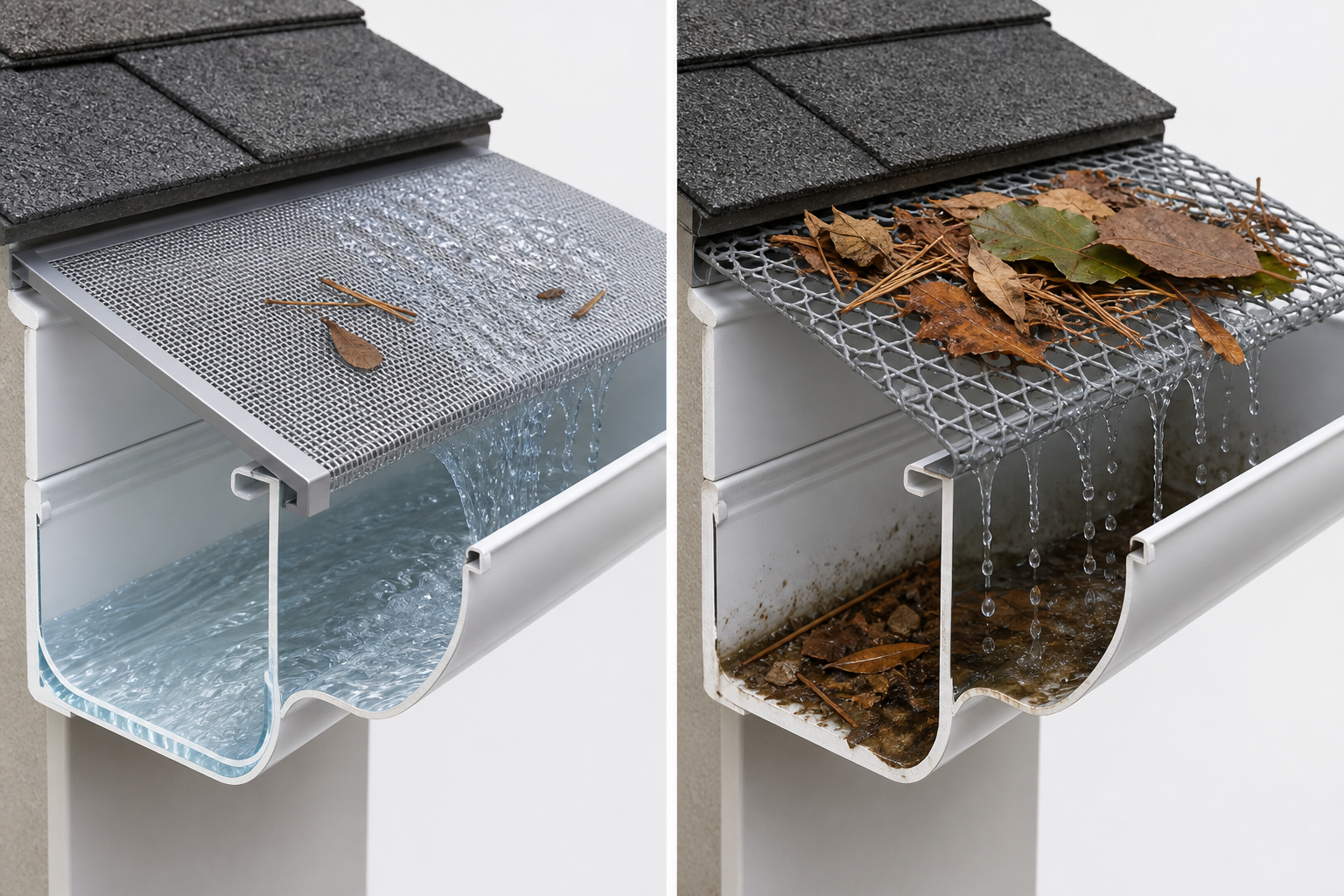
Gutter Guards vs Leaf Guards: Clearing Up the Confusion
If you’ve started researching ways to cut down on gutter maintenance, you’ve probably run into two terms that seem to be used interchangeably: gutter guards and leaf guards. So which one is actually right for your home? The truth is, the gutter guards vs leaf guards debate comes down to understanding what each term really means, since “leaf guard” is often just one specific type of gutter guard rather than a completely separate product category.
Wait — Aren’t Gutter Guards and Leaf Guards the Same Thing?
Sort of, yes. “Gutter guards” is the umbrella term for any product installed over or inside your gutters to block debris while letting water flow through. “Leaf guards” typically refers to a specific style within that category — usually a solid cover or fine mesh designed primarily to block leaves.
In other words, all leaf guards are gutter guards, but not all gutter guards are designed the same way or built to handle the same types of debris. Understanding the different styles is where the real decision-making happens.
Breaking Down the Main Types of Gutter Guards
1. Mesh Guards (Often Marketed as “Leaf Guards”)
Fine metal or vinyl mesh sits over the gutter opening, filtering out leaves and larger debris while letting rainwater pass through.
Best for: Homes with heavy leaf drop from deciduous trees
Watch out for: Very fine mesh can occasionally clog with small debris like seeds or shingle grit over time
2. Reverse-Curve (Surface Tension) Guards
These use a curved design so water clings to the surface and flows into the gutter, while leaves and debris slide off the edge entirely.
Best for: Homes that want minimal debris ever entering the gutter at all
Watch out for: Can struggle with very heavy rainfall if not sized correctly
3. Foam Inserts
Porous foam sits directly inside the gutter channel, allowing water to soak through while blocking leaves and twigs.
Best for: Budget-conscious homeowners looking for an affordable upgrade
Watch out for: Needs more frequent replacement than mesh or reverse-curve options
4. Brush Guards
A cylindrical brush sits inside the gutter trough, catching debris on top while water flows underneath.
Best for: Homes dealing with lighter debris, like smaller leaves or twigs
Watch out for: Less effective against heavy leaf buildup compared to mesh systems
Gutter Guards vs Leaf Guards: Key Differences to Consider
When people specifically search “leaf guards,” they’re usually comparing solid-cover or fine-mesh systems against other gutter guard styles. Here’s how they generally stack up:
- Leaf guards (mesh/solid cover): Excellent at blocking leaves specifically, but may need occasional cleaning for finer debris like pollen or grit
- Reverse-curve guards: Best all-around debris protection, but higher upfront cost
- Foam inserts: Lower cost, but shorter lifespan and more frequent replacement
- Brush guards: Simple and effective for light debris, less ideal for heavy leaf-dropping trees
The “best” option really depends on what your home is dealing with — a property surrounded by pine trees has very different needs than one with a few large maple trees nearby.
How to Choose the Right Option for Your Home
Consider Your Tree Coverage
- Heavy deciduous trees (oak, maple): Fine mesh or reverse-curve guards tend to perform best
- Coniferous trees (pine, fir): Look for finer mesh sizes designed to catch needles specifically
- Minimal tree coverage: A more basic option like foam inserts or brush guards may be sufficient
Consider Your Budget
- Lower upfront cost: Foam inserts or brush guards
- Mid-range: Standard mesh guards
- Higher upfront investment, longer lifespan: Reverse-curve systems
Consider Your Roof Pitch
Steeper roofs shed water faster, which can affect how well certain guard styles perform — something worth discussing with a local installer who understands your specific roofline.
Consider Long-Term Maintenance Goals
If your main goal is to virtually eliminate gutter cleaning, reverse-curve or high-quality mesh systems tend to offer the best long-term results, even with a higher initial cost.
Why Guards Alone Aren’t Always Enough
Here’s something worth knowing: gutter guards — whatever style you choose — are only as effective as the gutter system underneath them. If your existing gutters are already pitched incorrectly, undersized, or attached to worn-out fascia boards, adding guards on top won’t fix the underlying problem.
This is why pairing gutter guards with proper gutter installation Vernon homeowners trust is so important. A correctly installed, properly pitched gutter system gives your guards the best possible foundation to actually reduce maintenance long-term — instead of just masking issues that will eventually resurface.
Signs It’s Time to Upgrade Your Gutter System (With or Without Guards)
- Gutters older than 15–20 years
- Visible sagging or separation from the roofline
- Frequent overflow even during moderate rain
- Rust spots, cracks, or peeling paint on metal gutters
- Water pooling near your foundation after rainfall
If any of these sound familiar, it’s worth having your gutters inspected before adding any type of guard system on top.
When it comes to gutter guards vs leaf guards, the real decision isn’t about choosing between two totally different products — it’s about understanding which style of gutter guard best matches your home’s specific debris challenges, budget, and maintenance goals. Whether you land on mesh, reverse-curve, foam, or brush guards, the key is pairing that choice with a solid, properly installed gutter system underneath.
Ready to find the right gutter guard solution for your home? Reach out to the team at Heimann Gutters for a free assessment on gutter installation Vernon homeowners have trusted for years. They’ll help you choose the right gutter and guard combination based on your home’s trees, roofline, and budget.